MemoHoney Official Website › Articles › Reading badges
Reading badgesHow To Read a Supplement Badge Without Giving It Too Much Credit
Each MemoHoney badge makes a different claim. Read a badge as the statement it prints, not as a laboratory report, a personal recommendation, or proof of a clinical outcome.
Read each badge as a separate statement
The supplied MemoHoney artwork carries several small badges: Made In The USA, GMP, GMO Free, Natural Ingredients, Money Back, Clinician Formulated, No Gluten, Milk Free, and Vegetarian. They are easy to absorb as one general impression of quality. That is exactly why it helps to pull them apart. Each badge makes a different kind of statement, and each can be checked in a different way.
For example, Made In The USA concerns the filling and capping location, not the origin of every raw material. GMP concerns written procedures and records at a facility, not a personal test result for the bottle on a kitchen shelf. Money Back is a service promise with a stated 60-day period from purchase. Those are useful statements when read narrowly, and misleading when merged into an all-purpose claim.
The same rule protects the buyer as well as the seller. A reader can give a badge its due without treating it as a treatment claim, a laboratory report, or a personal recommendation. The product remains a dietary supplement; the actual ingredient and evidence questions remain separate from how the circles on the label are designed.
| Badge | What it can say | What it cannot establish alone |
|---|---|---|
| Made In The USA | A manufacturing location | Origin of every raw material or clinical effect |
| GMP | Facility procedures and records | A personal bottle assay |
| Money Back | A return promise and stated window | A predicted result |
| Clinician Formulated | A packaging representation | A named clinician or personal recommendation |
| No Gluten / Milk Free / Vegetarian | A formulation claim | The evidence level needed for every dietary reason |
A claim can be meaningful yet limited. Ask what would verify it before allowing it to settle a larger question.
Some badges can be checked, and some cannot
A useful way to read a badge is to ask what would have to be false for it to be wrong. A manufacturing-location statement can be checked against records. A GMP statement can be audited against a facility’s procedures. A gluten claim can be checked by asking for a testing result in parts per million. A money-back promise can be checked by asking how a current return is started and keeping the answer.
Natural Ingredients is different. The supplied note says it has no fixed definition that a buyer can test against. Clinician Formulated is also limited here: the materials do not name a clinician, field, role, or date. A buyer can fairly say the badge appears on the artwork. A buyer cannot identify the person behind it or know what they contributed from the badge alone.
This is not a reason to dismiss every badge. It is a reason to match confidence with documentation. A clear, checkable claim can be kept in its lane. An uncheckable phrase may still be part of the product’s presentation, but it should not be allowed to do the work of a panel, a release report, or a health professional who knows the buyer.
Food-restriction badges deserve a precise question
No Gluten, Milk Free, and Vegetarian can matter more to a buyer than an abstract quality claim. The same care applies. Someone avoiding gluten for a diagnosed reason needs the relevant testing detail, not only a circle on a product image. Someone avoiding milk proteins needs clarity about the formula and production context. Someone avoiding gelatin needs the shell material identified, rather than an assumption drawn from the word vegetarian.
The supplied artwork does not provide every underlying document. The responsible next step is to ask the seller a precise question before purchase and keep the answer. The question should name the actual restriction and the document or ingredient detail needed. A general support inbox cannot change what the label discloses, but it may be able to state what current documentation is available.
This is more useful than applying a one-size rule to every badge. The right standard depends on why the information matters. For a casual preference, a claim may be enough to consider. For a medical or strict dietary reason, an evidence level such as an assay figure or a named material may be necessary before buying.
A formulation badge is not a medical recommendation
Clinician Formulated sounds like a medical recommendation if it is read too quickly. The supplied material does not identify a clinician or say what role they had. It also does not create a personal recommendation for someone considering MemoHoney. A product label cannot see a person’s medicine list, blood pressure, history of reactions, or the reason a supplement is being considered.
That distinction matters with this ingredient list. Anyone taking a nitrate, a blood-pressure medicine, or a PDE5 inhibitor should bring the full label to a pharmacist or prescriber before starting. A buyer’s own clinician has a different role from an unnamed clinician badge: they can consider current medicines and conditions in context rather than making a general statement about a formula.
The same applies to memory change. Worsening forgetfulness, trouble with daily tasks, or a change noticed by family needs assessment. A supplement site can explain what an artwork prints and where an order question belongs. It should not let a small badge imply diagnosis, treatment, or a reason to postpone appropriate care.
Use a badge as a question prompt
A sound buying method is short. Read the badge literally. Find the label detail that supports it, if one is supplied. Ask for specific documentation when it would affect the decision. Save any written answer with the order record. Then make the purchase decision from what is actually known rather than from a general feeling produced by many small circles together.
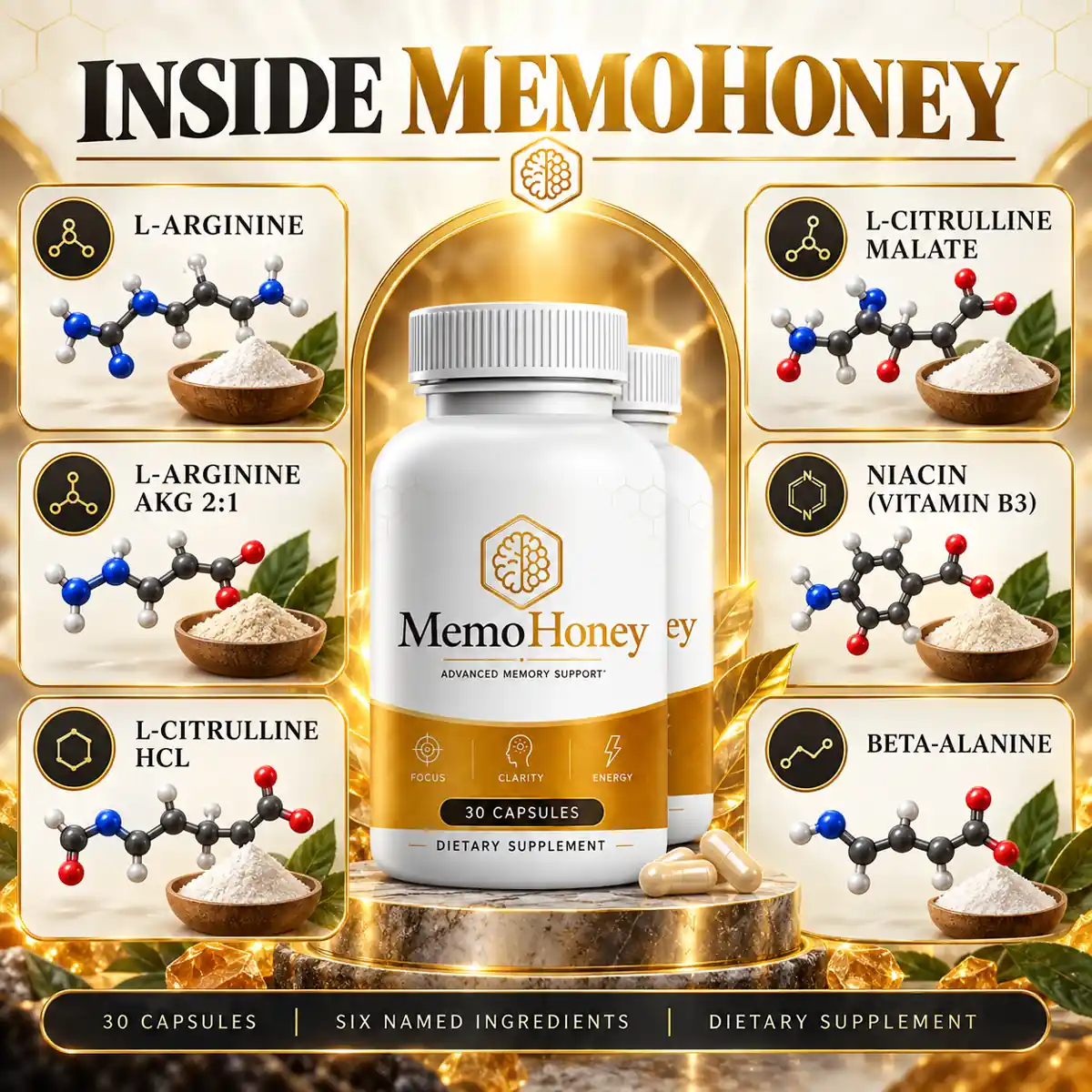
The ingredients page separates the six named ingredients from the claims around them. Testing and quality explains what this site has and has not been supplied. Those pages are not a substitute for a clinician, but they make a badge less likely to become a claim that it never made.
The quiet advantage of this method is that it works whether the answer is reassuring, incomplete, or inconvenient. A product is not made safer by a reader guessing. It is made easier to assess when the reader knows what each badge can support and where the evidence stops.
Read the MemoHoney label with this beside you
Six named ingredients, the amount each published trial used printed next to them, and 60 days from the date of purchase to decide.
Two bottles $158 · six bottles $294 · 60-day money-back guarantee
Take Me To The MemoHoney CheckoutRun MEM-26/ME-5895 · a single capsule each morning · thirty in every bottle · posted within the U.S.
Keep evidence in order
One final check keeps a product page from becoming a collection of accidental claims. A badge says what its own words say. A label gives a buyer the facts printed on it. An order confirmation identifies a purchase. A service reply records what the seller said. A study reports the product and dose it actually tested. These sources can all be useful, but none should be promoted into a different kind of evidence by design or repetition.
That ordering leaves room for a clear negative decision. If the detail that matters to a buyer is not supplied, the buyer can leave the item unpurchased rather than invent a favourable answer. That is a normal, careful outcome. It does not require assuming the product is good or bad; it requires only recognising what the available record can and cannot settle before the return window has begun.
The same discipline helps after a purchase. Keep the order and service record for the transaction, keep the label for an ingredient question, and keep health concerns in the care setting where they can be evaluated. A buyer does not need to turn every uncertainty into a conclusion. It is enough to keep the source, ask the next precise question, and let the answer change the decision only where it actually applies.
A clear record is particularly valuable when the information is incomplete. It gives a buyer a reliable place to return to, instead of relying on an impression of what a page or product image seemed to promise. That is how a label, a badge, a return term, and a service reply remain useful without being made to carry more authority than they have.
- Read each badge as a separate claim rather than as a general proof of quality.
- Ask what fact or document would verify the claim that matters to you.
- Use a named material or test result for strict dietary or medical restrictions.
- Treat a formulation badge as a prompt for questions, not personal medical advice.
- Bring medicines, symptoms, and memory concerns to a pharmacist or clinician.
What follows is information about a dietary supplement and not advice about anybody's health. Forgetfulness somebody else has remarked on, or a decline that is visibly steeper this month than last, is a reason to book an appointment rather than to read further. MedlinePlus lists what is worth mentioning when you do.
- Questions and Answers on Dietary Supplements. U.S. Food and Drug Administration. https://www.fda.gov/food/information-consumers-using-dietary-supplements/questions-and-answers-dietary-supplements
- Using Dietary Supplements Wisely. National Center for Complementary and Integrative Health, National Institutes of Health. https://www.nccih.nih.gov/health/using-dietary-supplements-wisely
- Memory. MedlinePlus, U.S. National Library of Medicine. https://medlineplus.gov/memory.html
- Cohen PA, Avula B, Khan I. The unapproved drug centrophenoxine (meclofenoxate) in cognitive enhancement dietary supplements. Clin Toxicol (Phila). 2022;60(10):1156-1158. PMID 35959800. https://pubmed.ncbi.nlm.nih.gov/35959800/
- Dolan E, Swinton PA, Painelli VS, et al. A Systematic Risk Assessment and Meta-Analysis on the Use of Oral β-Alanine Supplementation. Adv Nutr. 2019;10(3):452-463. PMID 30980076. https://pubmed.ncbi.nlm.nih.gov/30980076/