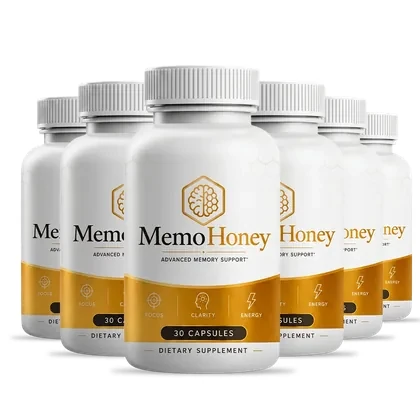
MemoHoney Official Website › Guides
GuidesGuides And Longer Reading From This Desk
Two long guides, five blog posts and the reference list behind all of them.
The guides are about the category rather than about one bottle: how to choose a memory supplement, and what the evidence in this field actually supports. Neither is written to sell anything, which is why neither carries a product name in its headings.
Everything on this website that is longer than a product page and less interested in selling you a bottle.
The two long guides
Two pieces, both about the category rather than about one product.
Choosing a memory supplement
Seven questions to ask of any product on this shelf, in the order worth asking them, with the answer this particular bottle gives to each. Written so it works on a competitor's label as well as on this one.
The memory supplement guide
What the evidence in this field actually supports, which is a shorter list than the shelf suggests, and where the amino-acid formulas sit within it. Includes the three interventions with randomised trials behind them that nobody sells in a bottle.
The blog
Five posts, reached from here and from the footer rather than from the main menu.
Five posts, each on a question this particular panel raises rather than on a template topic. They run fifteen hundred to two thousand words, they carry their own reference lists, and they are indexed at the blog.
The topics were chosen the way the guides were: by asking what a reader holding this bottle would actually want settled. What the number stamped on the base is for. Why the container and the sales page never say the same thing. How a watermelon compound from the sports aisle ended up on a memory label. How to test a supplement honestly over sixty days. And what the missing panel on the back would have told anybody.
None of the five is a review of the product, and none of them is a list of ten things you did not know about your brain. Each takes a single question that the artwork or the ladder actually raises and follows it until it runs out, which is usually two or three sections further than a product page has room for. Where a post costs the product something, it says so rather than steering around it, and the last of the five costs it the most.
The reference list behind this website
How thirty-six references were resolved, checked and then checked again.
Thirty-six sources are cited across this website: thirty-two published papers and four government fact sheets. Every PubMed record was resolved through the NCBI service on 21 September 2026 and each citation line was written from the fields that service returned, rather than from memory.
Each was then swept a second time, through the same service, for retraction notices and comment records. That pass returned one flag across the thirty-two, an erratum on the Ginkgo Evaluation of Memory trial, which is a correction notice rather than a withdrawal.
Two papers were deliberately left out. The most-quoted citrulline blood-pressure meta-analysis in this category has been retracted, and PubMed carries the notice; anything this website says about citrulline and blood pressure rests on the 2025 meta-analysis and the 2019 Nutrients review instead. And the American Academy of Neurology's mild cognitive impairment guideline is flagged retired in PubMed, so it is not quoted as a current standard of care.
The full list, in the order the ingredients appear on the artwork, is at the foot of the ingredients page, and each page prints only the subset it actually cites.
The five posts, and why these five
Five questions this panel raises, and one that it would rather not.
| Post | The question it answers |
|---|---|
| What a lot number on a supplement bottle is actually for | The one verifiable thing a buyer holds. What a production run is, what the stamp on the base settles, and what it very much does not |
| Why the bottle and the sales page never quite match | Two surfaces governed by two sets of rules, and the one-minute technique for reading the distance between them |
| How citrulline reached a memory label | A watermelon compound out of blood-pressure and sports research, and what the migration between categories costs in evidence |
| How to run a fair sixty-day test on any supplement | Three lines on day one, one variable at a time, and readings at thirty and sixty days. The apparatus costs a minute |
| What a Supplement Facts panel would have to say | Field by field, what each one settles, and what to do when the artwork does not include one |
Chosen by asking what a reader holding this particular bottle would want settled, rather than from a list of category keywords.
Each post runs fifteen hundred to two thousand words on its own article column, carries a table of contents, at least two images from the product's own artwork, a comparison table and its own short reference list. They are reached from here, from the footer and from the sitemap rather than from the main menu, because they are reading rather than product pages.
What this desk publishes, and what it refuses to
Six things on each side, and the right-hand column is the one that took the decisions.
Published here
- The label quoted as printed, including the three words on the gold band
- The seller's five claims quoted in full rather than paraphrased
- Each ingredient beside the amount its own trials used, with the population attached
- The run number and the certificate reference, before purchase
- The commercial terms in the conservative reading, including the postage the buyer pays
- A list of what this desk cannot check, kept current
Refused here
- A milligram figure for any ingredient, because the artwork carries no panel
- A named medical reviewer, because inventing one is the commonest fabrication on this shelf
- A claim that the capsule improves memory, because no trial of it exists
- Eight separate review texts, because the distributor supplied two
- A deadline computed from a shipping date, because the window runs from purchase
- A certificate of analysis, because this counter holds the reference and not the document
Where to start, depending on what you came for
Six starting points, and the first one covers most readers.
| If you want | Start at |
|---|---|
| The short version of everything | The home page, which answers each question in a paragraph with a route on |
| What is in the capsule | Ingredients, and the trial comparison inside it |
| Whether it suits you | Who it is for, which is mostly about who it does not suit |
| What it costs and what the window reaches | Pricing and the guarantee |
| How to judge it honestly | The results timeline |
| The category rather than the product | The two guides above |
Twenty-five pages is a lot to arrive at from a search box. This table is the shortest route through them.
About this desk and its method
Six sources under this page, and the method behind all thirty-six.
- Luo P, Chen J, Liu K, et al. Does l-citrulline supplementation and watermelon intake reduce blood pressure in middle-aged and older adults? A systematic review and meta-analysis of randomized controlled trials. Clin Nutr ESPEN. 2025;69:653-664. PMID 40789388. https://pubmed.ncbi.nlm.nih.gov/40789388/
- Khalaf D, Krüger M, Wehland M, et al. The Effects of Oral l-Arginine and l-Citrulline Supplementation on Blood Pressure. Nutrients. 2019;11(7):1679. PMID 31336573. https://pubmed.ncbi.nlm.nih.gov/31336573/
- DeKosky ST, Williamson JD, Fitzpatrick AL, et al. Ginkgo biloba for prevention of dementia: a randomized controlled trial. JAMA. 2008;300(19):2253-62. PMID 19017911. https://pubmed.ncbi.nlm.nih.gov/19017911/
- Using Dietary Supplements Wisely. National Center for Complementary and Integrative Health, National Institutes of Health. https://www.nccih.nih.gov/health/using-dietary-supplements-wisely
- Questions and Answers on Dietary Supplements. U.S. Food and Drug Administration. https://www.fda.gov/food/information-consumers-using-dietary-supplements/questions-and-answers-dietary-supplements
- Memory. MedlinePlus, U.S. National Library of Medicine. https://medlineplus.gov/memory.html