MemoHoney Official Website › Ingredients
IngredientsMemoHoney Ingredients: The Six Names, And What Their Trials Gave People
Six ingredients are named on the MemoHoney artwork and no amount is given for any of them.
They are L-Arginine, L-Arginine AKG 2:1, L-Citrulline HCL, L-Citrulline Malate, Niacin as vitamin B3, and Beta-Alanine. Five come out of nitric-oxide and sports research; the sixth is a B vitamin. This page prints each one beside the amount its own published trials used.
Six names, six bodies of research, and one honest comparison. The bottle gives a list; the literature gives numbers; what follows is both, side by side.
Where the MemoHoney ingredient list comes from
One graphic decides what this page is allowed to say.
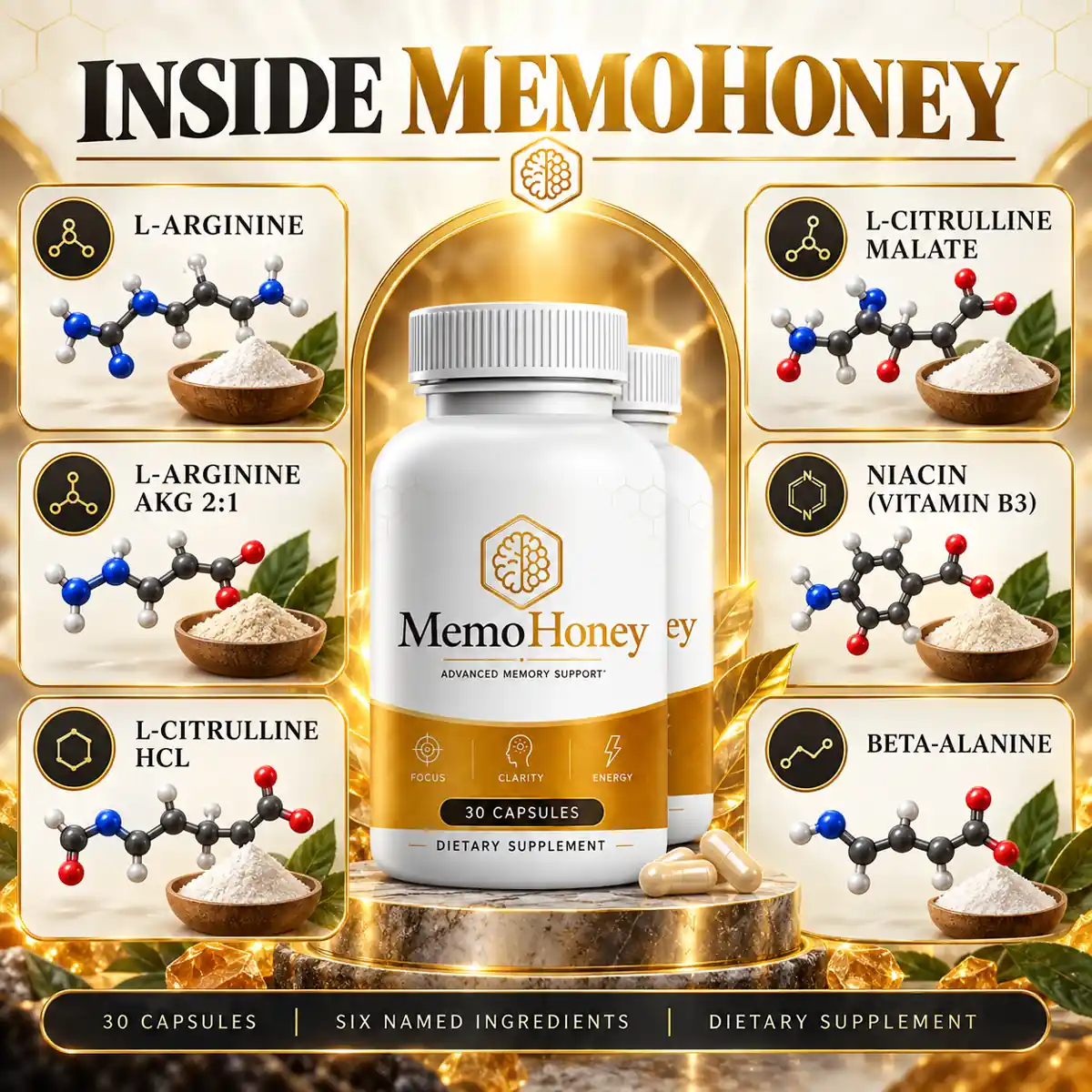
The list on this page is read off the vendor's own INSIDE MEMOHONEY graphic, which tiles all six names with a molecular model and a bowl of powder beside each. That graphic is the authority for the count, and the count is six.
The front of the bottle adds the framing rather than the contents: Advanced Memory Support under the brand, and a gold band spacing out Focus, Clarity and Energy. Beneath that sits a dark pill reading 30 CAPSULES, and beneath that, DIETARY SUPPLEMENT.
Missing from all of it is a Supplement Facts panel. Nothing states a serving weight, nothing carries a percent Daily Value, and no other-ingredients line appears anywhere, which leaves the quantity of each of the six unknowable from outside the factory. No figure is estimated here. What appears instead, further down the page, is the only comparison anybody can make honestly.
The six MemoHoney ingredients, one at a time
Each card carries the same three things: what the molecule does, where its published work sits, and how much of it that work actually used.
L-Arginine
Amino acidAn enzyme in the lining of a blood vessel takes arginine and makes nitric oxide out of it. The gas lasts seconds, reaches the ring of muscle around the vessel and tells it to slacken. Getting arginine there by mouth is the hard part, because two sets of enzymes stand in the way.
Where the research sits. Blood pressure, vascular function and exercise capacity. Read the study behind that line.
What those studies gave people. Gram-scale in every supplement trial. One labelled-meal study followed a single dietary dose to find out what fraction ever became the gas.
L-Arginine AKG 2:1 Extract
Amino acid saltPairing arginine with alpha-ketoglutarate is supposed to get more of it through absorption intact than the plain amino acid manages. Whether it does was tested at twelve grams a day, and the answers came back mixed.
Where the research sits. Resistance training and forearm blood flow in trained young men. Read the study behind that line.
What those studies gave people. Twelve grams daily in the trial that tracked blood levels, taken as three doses of four, and twelve grams daily again over a week of training.
L-Citrulline HCL
Amino acid saltThe enzymes that dismantle swallowed arginine leave citrulline alone, so it arrives whole and is turned into arginine downstream. That detour is why a precursor beats the thing it is a precursor for, and why this molecule has a literature of its own.
Where the research sits. Blood flow to the head during hard interval exercise. Read the study behind that line.
What those studies gave people. Eight point eight grams daily across five days, in the only trial that looked at blood flow to the head.
L-Citrulline Malate
Amino acid saltMalic acid instead of hydrochloride as the partner. It matters for a plain reason rather than a chemical one: when a paper reports that citrulline helped a sprint or a set of leg presses, this is generally what was in the sachet.
Where the research sits. Repeated sprints, resistance training, and lower-limb function in older women. Read the study behind that line.
What those studies gave people. Three days at eight grams daily; a head-to-head of eight against twelve in one sitting; three grams daily for six weeks beside supervised training.
Niacin (Vitamin B3)
VitaminNiacin becomes NAD and NADP inside the body, and those two carry electrons through the reactions that keep a cell supplied with energy. Neurons are expensive cells and lean on that machinery heavily. Severe long-term shortage produces pellagra, described historically by three symptoms, the third of them cognitive.
Where the research sits. A long-running dietary cohort, and an observational B-vitamin study. Read the study behind that line.
What those studies gave people. Diets supply somewhere in the low tens of milligrams daily, and 35 mg is where the supplemental ceiling for this country was set.
Beta-Alanine
Amino acidTwo amino acids make carnosine and only one of them is ever scarce, so supplying beta-alanine is what moves the total. Carnosine mops up acid inside working muscle, and it also turns up in brain tissue. That second fact is the thread this ingredient hangs from.
Where the research sits. Exercise capacity, plus one brain-imaging trial in 60 to 80-year-olds. Read the study behind that line.
What those studies gave people. Twelve weeks at 2.4 grams daily in the scanner trial; between 3.2 and 6.4 grams daily across the pooled exercise studies.
Each MemoHoney ingredient against the amount its own trials used
Three columns: the name, what the artwork says about it, and what the published work gave somebody.
That right-hand column is the whole argument of this page. A standard double-zero capsule holds roughly 700 to 900 mg of a powder blend before any filler or shell, and the trials in that column are written in grams. Six ingredients sharing less than a gram cannot each sit at a gram-scale amount, and no bottle needs to be opened to work that out.
Niacin is the single exception. It is the one ingredient here whose useful amount fits comfortably inside a capsule of this size, because the systematic review behind the US upper intake level put that level at 35 mg a day from supplements. Whether this capsule holds 5 mg or 30 mg cannot be read off the artwork, and this desk prints no guess for it.
The right conclusion from all of that is narrower than either extreme. It is not that the capsule does nothing, because sub-trial amounts of several substrates are not the same as an empty capsule. It is that the capsule is untested rather than disproved, and that anybody carrying a gram-scale trial result across to this bottle is crossing a gap the label gives them no way to measure.
Why MemoHoney names citrulline twice and arginine twice
Two arginines and two citrullines is not four ingredients. It is two decisions.
Read as six separate items the list looks padded. Read as three pairs it makes considerably more sense, and the pairing is deliberate chemistry rather than label decoration.
Arginine is the molecule the enzyme actually uses to make nitric oxide, and it is also the one that survives swallowing worst: enzymes in the gut wall and the liver take most of an oral dose before it reaches the circulation. Citrulline is absorbed largely untouched and converted to arginine by the kidney afterwards, which is why the human availability work and the pharmacokinetic work on that conversion both point the same way. Putting both on a label covers the direct route and the durable one.
The two salts are a different kind of pairing. Arginine AKG binds arginine to alpha-ketoglutarate, and citrulline malate binds citrulline to malic acid. The salt changes how the compound is absorbed and handled, and in the case of citrulline malate it matters for a plainer reason: it is the form nearly every sports trial actually used, so when a study reports that citrulline improved a repeated sprint, this is usually the compound that was in the sachet.
Arginine AKG is the weakest link in the list on the published evidence. The pharmacokinetic trial gave 12 g a day split three ways; three grams taken once ahead of a single session shifted none of the measurements taken; and seven days of it at 12 g a day is the trial that measured blood flow. A capsule sharing under a gram between six ingredients is a long way below all three.
The two MemoHoney ingredients that are not about blood flow
One vitamin with an observational history, one amino acid with a single imaging trial.
Niacin and beta-alanine sit outside the nitric-oxide story and each is there for its own reason.
Niacin becomes NAD and NADP in the body, the two electron carriers every cell runs its energy metabolism on. The cognitive thread behind it is old and observational rather than randomised: a Chicago cohort of older adults reported that people with the lowest dietary niacin intakes had the highest rate of incident Alzheimer's disease, and a more recent observational study of dietary B vitamins points in a similar direction. Observational is the important word: neither can separate niacin from everything else that goes with a better diet.
Beta-alanine is the rate-limiting half of carnosine, an acid buffer present in muscle and in brain tissue. Its case here rests on one small trial: 2.4 g a day for twelve weeks in 60 to 80-year-olds improved fractional anisotropy scores in the hippocampus and the amygdala, which is a measurement of white-matter structure rather than a memory test. The carnosine arm of the NEAT trial is the nearest thing to a cognitive endpoint in that literature, and it reported its benefit in younger participants.
What is not in the MemoHoney list, and why that is worth knowing
A blood-flow formula on a shelf full of botanical ones, and what that changes about the comparison.
The six names are the whole declared formula. There is no ginkgo, no bacopa, no huperzine, no citicoline and no phosphatidylserine, which are the ingredients most buyers of a memory capsule will have seen elsewhere. That is a real difference in approach rather than an omission: this is a blood-flow formula and those are botanical and phospholipid formulas.
It also means the comparison a reader should make is with other nitric-oxide stacks, most of which are sold in the sports aisle in scoops rather than capsules, and most of which do print their amounts because their whole selling proposition is the size of the scoop. That is the sharpest thing that can fairly be said about this label: its own category convention is to state grams, and this artwork states none.
One thing that is genuinely absent from this category more widely is worth a sentence, because it is the reason regulators pay attention at all. An analysis of nootropic supplements found an unapproved drug, centrophenoxine, in products sold as dietary supplements. Nothing on this bottle belongs to that class, and a plain six-name amino-acid list is exactly the sort of label that makes that easy to verify.
Sources behind this MemoHoney page, and who wrote it
Eleven sources under this page, each linked where the sentence it supports is written.
- Mariotti F, Petzke KJ, Bonnet D, et al. Kinetics of the utilization of dietary arginine for nitric oxide and urea synthesis: insight into the arginine-nitric oxide metabolic system in humans. Am J Clin Nutr. 2013;97(5):972-9. PMID 23535108. https://pubmed.ncbi.nlm.nih.gov/23535108/
- Rougé C, Des Robert C, Robins A, et al. Manipulation of citrulline availability in humans. Am J Physiol Gastrointest Liver Physiol. 2007;293(5):G1061-7. PMID 17901164. https://pubmed.ncbi.nlm.nih.gov/17901164/
- Song S, Thapa SK, Upadhyay M, et al. Quantitative characterization of L-citrulline as a precursor of L-arginine in rats: pharmacokinetic basis for nitric oxide-mediated effects. Front Pharmacol. 2026;17:1889835. PMID 42755674. https://pubmed.ncbi.nlm.nih.gov/42755674/
- Wax B, Kavazis AN, Webb HE, et al. Acute L-arginine alpha ketoglutarate supplementation fails to improve muscular performance in resistance trained and untrained men. J Int Soc Sports Nutr. 2012;9(1):17. PMID 22510253. https://pubmed.ncbi.nlm.nih.gov/22510253/
- Willoughby DS, Boucher T, Reid J, et al. Effects of 7 days of arginine-alpha-ketoglutarate supplementation on blood flow, plasma L-arginine, nitric oxide metabolites, and asymmetric dimethyl arginine after resistance exercise. Int J Sport Nutr Exerc Metab. 2011;21(4):291-9. PMID 21813912. https://pubmed.ncbi.nlm.nih.gov/21813912/
- Morris MC, Evans DA, Bienias JL, et al. Dietary niacin and the risk of incident Alzheimer's disease and of cognitive decline. J Neurol Neurosurg Psychiatry. 2004;75(8):1093-9. PMID 15258207. https://pubmed.ncbi.nlm.nih.gov/15258207/
- Minto C, Vecchio MG, Lamprecht M, et al. Definition of a tolerable upper intake level of niacin: a systematic review and meta-analysis of the dose-dependent effects of nicotinamide and nicotinic acid supplementation. Nutr Rev. 2017;75(6):471-490. PMID 28541582. https://pubmed.ncbi.nlm.nih.gov/28541582/
- Chen Q, Huang J, Shi X, et al. Associations between dietary B vitamin intakes and cognitive function among elderly individuals: An observational study. Nutrition. 2025;134:112716. PMID 40056822. https://pubmed.ncbi.nlm.nih.gov/40056822/
- Ostfeld I, Zamir A, Ben-Zeev T, et al. β-Alanine supplementation improves fractional anisotropy scores in the hippocampus and amygdala in 60-80-year-old men and women. Exp Gerontol. 2024;194:112513. PMID 38971131. https://pubmed.ncbi.nlm.nih.gov/38971131/
- O'Toole TE, Amraotkar AR, Gao H, et al. Carnosine supplementation improves cognitive outcomes in younger participants of the NEAT trial. Neurotherapeutics. 2025;22(2):e00541. PMID 39919936. https://pubmed.ncbi.nlm.nih.gov/39919936/
- Cohen PA, Avula B, Khan I. The unapproved drug centrophenoxine (meclofenoxate) in cognitive enhancement dietary supplements. Clin Toxicol (Phila). 2022;60(10):1156-1158. PMID 35959800. https://pubmed.ncbi.nlm.nih.gov/35959800/
More about MemoHoney
Order MemoHoney and check the run number yourself
Six names, thirty capsules and lot MEM-26/ME-5895 printed before you buy. One capsule a morning, sixty days from purchase to decide.
Two bottles $158 · six bottles $294 · 60-day money-back guarantee
Take Me To The MemoHoney CheckoutRun MEM-26/ME-5895 · a single capsule each morning · thirty in every bottle · posted within the U.S.