MemoHoney Official Website › Memory Supplement Guide
Memory Supplement GuideThe Memory Supplement Guide: What The Evidence Supports
The list of things with randomised evidence behind them for cognition is shorter than the shelf suggests, and almost none of it is sold in a bottle.
Hearing treatment, blood-pressure control and sleep all have trials. A plain multivitamin has two. The botanical formulas have the longest history and the most disappointing large trial. Amino-acid formulas sit outside all of it.
A map of the field, written by a counter that sells one product in it and has more to lose than gain by drawing it accurately.
What has randomised evidence behind it
Four interventions with randomised trials, and where each one sits.
| Intervention | The trial | What it found |
|---|---|---|
| Hearing treatment | ACHIEVE, published in the Lancet in 2023 | Randomised older adults with hearing loss to hearing intervention or health education. Slower cognitive decline in the higher-risk group |
| Blood-pressure control | SPRINT MIND, published in JAMA in 2019 | Intensive blood-pressure control produced fewer cases of probable dementia than standard control |
| Sleep | the consolidation literature, reviewed in 2026 | Memory consolidation during sleep is among the better-established findings in the whole of cognitive neuroscience |
| A daily multivitamin | COSMOS-Web and COSMOS-Mind | Both reported memory benefits in older adults from a plain daily multivitamin, which is the most unglamorous finding in this field |
Three of those four are not products. The fourth costs a few dollars a month and makes no interesting claims.
That table is the honest starting point for anybody thinking about their own memory, and a supplement counter is an odd place to find it. It is here because a reader who has not addressed hearing, blood pressure and sleep is spending money on the fourth-best lever, and knowing that is worth more than any product page.
The three approaches the supplement shelf takes
Three camps, three theories, and what each has behind it.
Botanical formulas
Ginkgo, bacopa, huperzine. The longest trial history in the field and the most sobering large result: the Ginkgo Evaluation of Memory trial followed more than three thousand older adults for a median 6.1 years and found no reduction in dementia.
Phospholipid and choline formulas
Citicoline, phosphatidylserine, alpha-GPC. Sold on the raw material a nerve cell membrane is built from. Smaller literature, generally smaller trials, and the most plausible-sounding mechanism of the three.
Blood-flow formulas
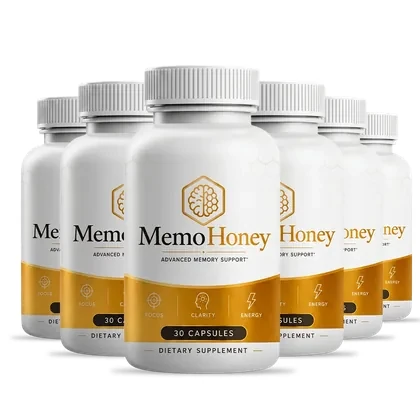
Citrulline, arginine and their salts, sometimes with beta-alanine. Good vascular evidence at gram amounts, almost no cognitive endpoints. This is the camp MemoHoney belongs to, and its six names say so.
Three theories of what is wrong. The botanical camp thinks the problem is oxidative and inflammatory. The phospholipid camp thinks it is structural. The blood-flow camp thinks it is circulatory, on the argument that an organ taking a fifth of the body's oxygen budget is the first to notice when delivery is sluggish.
None of the three has a randomised trial of a finished commercial formula showing a memory benefit in ordinary adults. That is the state of the field and it is worth stating once, clearly, rather than implying gently.
Where the amino-acid formulas actually sit
Four bodies of evidence, none of which is about a finished capsule.
The vascular evidence for citrulline and arginine is real and it is not about memory. The 2025 meta-analysis of citrulline and watermelon intake found a modest systolic reduction in middle-aged and older adults, and the 2019 Nutrients review reaches a similar place for both compounds.
The single trial that comes closest to a cognitive endpoint measured cerebrovascular function rather than cognition, in taekwondo athletes during sprint interval training, at 8.8 g a day for five days. That is the nearest thing this whole camp has to a brain outcome, and it is a long way from a capsule taken by a fifty-five-year-old at breakfast.
Beta-alanine has one imaging trial in 60 to 80-year-olds which moved a white-matter measurement, and a carnosine arm of the NEAT trial which reported a cognitive benefit in younger participants. Niacin's cognitive thread is observational and cannot separate the vitamin from the diet it arrives in.
Put together, that is an interesting hypothesis with no test of it. Which is a fair description of this whole camp, and of the product this website sells.
What to be careful of on this shelf
Three things, and the first one applies to almost every product in the category.
Three things, in descending order of how often they matter.
The first is the amount gap, which is the subject of most of this website. A label naming an ingredient with a famous trial behind it, at an amount it does not disclose, is borrowing that trial's credibility without taking on its dose. It is legal, it is extremely common, and reading the trial amount is the entire defence.
The second is the disease word. A supplement may say it supports the normal working of a system. It may not say it treats, prevents or cures anything. A page that slides into treatment language is either a reseller writing its own copy or a product that has stopped caring, and both are reasons to close the tab.
The third is rarer and more serious. An analysis of cognitive-enhancement supplements found an unapproved drug, centrophenoxine, in products sold as dietary supplements in this market. The defence against that is a plain, complete, named ingredient list, which is a genuine point in favour of a label like this one.
A sensible order of operations
Six steps, and a supplement counter has put itself sixth on purpose.
- Rule out the treatable. A change other people have noticed, or one that is worsening month on month, is an appointment rather than a purchase.
- Fix sleep if it is broken. It is free, it is the largest single lever on next-day memory, and it will otherwise swamp any test you run.
- Get hearing checked if there is any doubt. It has the strongest randomised evidence in this whole table and nobody sells it in a bottle.
- Get blood pressure measured and treated if it needs it. Second strongest, same observation.
- Consider a plain daily multivitamin, which is cheap and has two randomised trials behind it for memory in older adults.
- Then, if you want to try something from the shelf, pick a camp, read the trial amounts, and run a fair sixty days against three lines written down on day one.
Sources and method behind this guide
Thirteen sources under this guide, which is the longest reference list on this website and the one it would be hardest to write without.
- Lin FR, Pike JR, Albert MS, et al. Hearing intervention versus health education control to reduce cognitive decline in older adults with hearing loss in the USA (ACHIEVE): a multicentre, randomised controlled trial. Lancet. 2023;402(10404):786-797. PMID 37478886. https://pubmed.ncbi.nlm.nih.gov/37478886/
- Williamson JD, Pajewski NM, Auchus AP, et al. Effect of Intensive vs Standard Blood Pressure Control on Probable Dementia: A Randomized Clinical Trial. JAMA. 2019;321(6):553-561. PMID 30688979. https://pubmed.ncbi.nlm.nih.gov/30688979/
- Yasser E, Ayache L, El Khayat H, et al. Sleep and memory consolidation: Neural and cognitive perspectives. Prog Brain Res. 2026;299:137-176. PMID 42547206. https://pubmed.ncbi.nlm.nih.gov/42547206/
- Yeung LK, Alschuler DM, Wall M, et al. Multivitamin Supplementation Improves Memory in Older Adults: A Randomized Clinical Trial. Am J Clin Nutr. 2023;118(1):273-282. PMID 37244291. https://pubmed.ncbi.nlm.nih.gov/37244291/
- Baker LD, Manson JE, Rapp SR, et al. Effects of cocoa extract and a multivitamin on cognitive function: A randomized clinical trial. Alzheimers Dement. 2023;19(4):1308-1319. PMID 36102337. https://pubmed.ncbi.nlm.nih.gov/36102337/
- DeKosky ST, Williamson JD, Fitzpatrick AL, et al. Ginkgo biloba for prevention of dementia: a randomized controlled trial. JAMA. 2008;300(19):2253-62. PMID 19017911. https://pubmed.ncbi.nlm.nih.gov/19017911/
- Luo P, Chen J, Liu K, et al. Does l-citrulline supplementation and watermelon intake reduce blood pressure in middle-aged and older adults? A systematic review and meta-analysis of randomized controlled trials. Clin Nutr ESPEN. 2025;69:653-664. PMID 40789388. https://pubmed.ncbi.nlm.nih.gov/40789388/
- Khalaf D, Krüger M, Wehland M, et al. The Effects of Oral l-Arginine and l-Citrulline Supplementation on Blood Pressure. Nutrients. 2019;11(7):1679. PMID 31336573. https://pubmed.ncbi.nlm.nih.gov/31336573/
- Li A, Li H, Chen J. The effects of L-citrulline supplementation on cerebrovascular function during sprint interval training in taekwondo athletes. J Exerc Sci Fit. 2025;23(3):222-228. PMID 40474881. https://pubmed.ncbi.nlm.nih.gov/40474881/
- Ostfeld I, Zamir A, Ben-Zeev T, et al. β-Alanine supplementation improves fractional anisotropy scores in the hippocampus and amygdala in 60-80-year-old men and women. Exp Gerontol. 2024;194:112513. PMID 38971131. https://pubmed.ncbi.nlm.nih.gov/38971131/
- O'Toole TE, Amraotkar AR, Gao H, et al. Carnosine supplementation improves cognitive outcomes in younger participants of the NEAT trial. Neurotherapeutics. 2025;22(2):e00541. PMID 39919936. https://pubmed.ncbi.nlm.nih.gov/39919936/
- Morris MC, Evans DA, Bienias JL, et al. Dietary niacin and the risk of incident Alzheimer's disease and of cognitive decline. J Neurol Neurosurg Psychiatry. 2004;75(8):1093-9. PMID 15258207. https://pubmed.ncbi.nlm.nih.gov/15258207/
- Cohen PA, Avula B, Khan I. The unapproved drug centrophenoxine (meclofenoxate) in cognitive enhancement dietary supplements. Clin Toxicol (Phila). 2022;60(10):1156-1158. PMID 35959800. https://pubmed.ncbi.nlm.nih.gov/35959800/